


Document signing with BankID
Send documents for signing directly from the workspace. Invite board members or external parties by email and let everyone sign with BankID — legally binding, without uploading files to a separate tool.
Keep every document in order with clear structure and permission control.
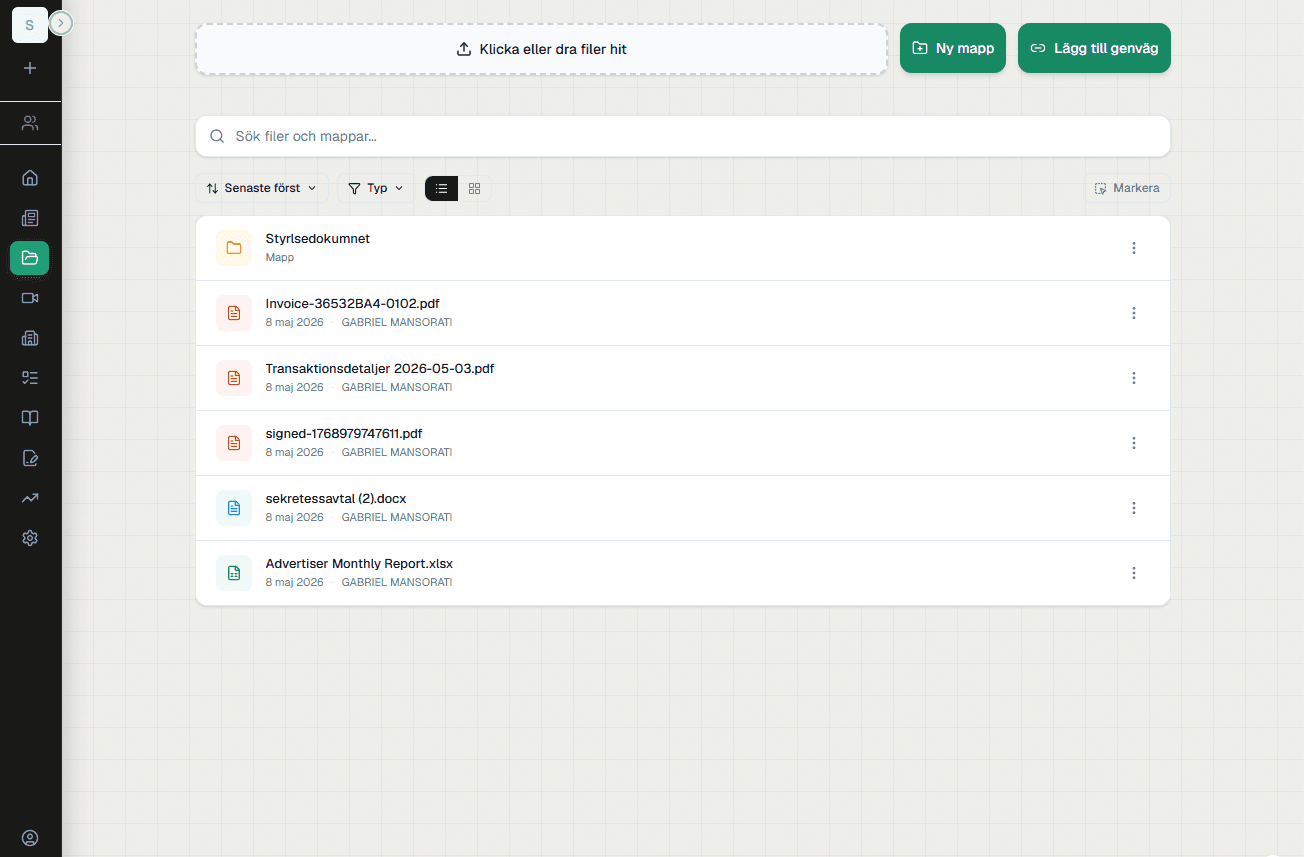
Files view with upload zone, search and a structured archive
Tools the board actually uses — every week.
From legally binding signing to collected shortcuts and a traceable archive. All in one place.
Send documents for signing directly from the workspace. Invite board members or external parties by email and let everyone sign with BankID — legally binding, without uploading files to a separate tool.
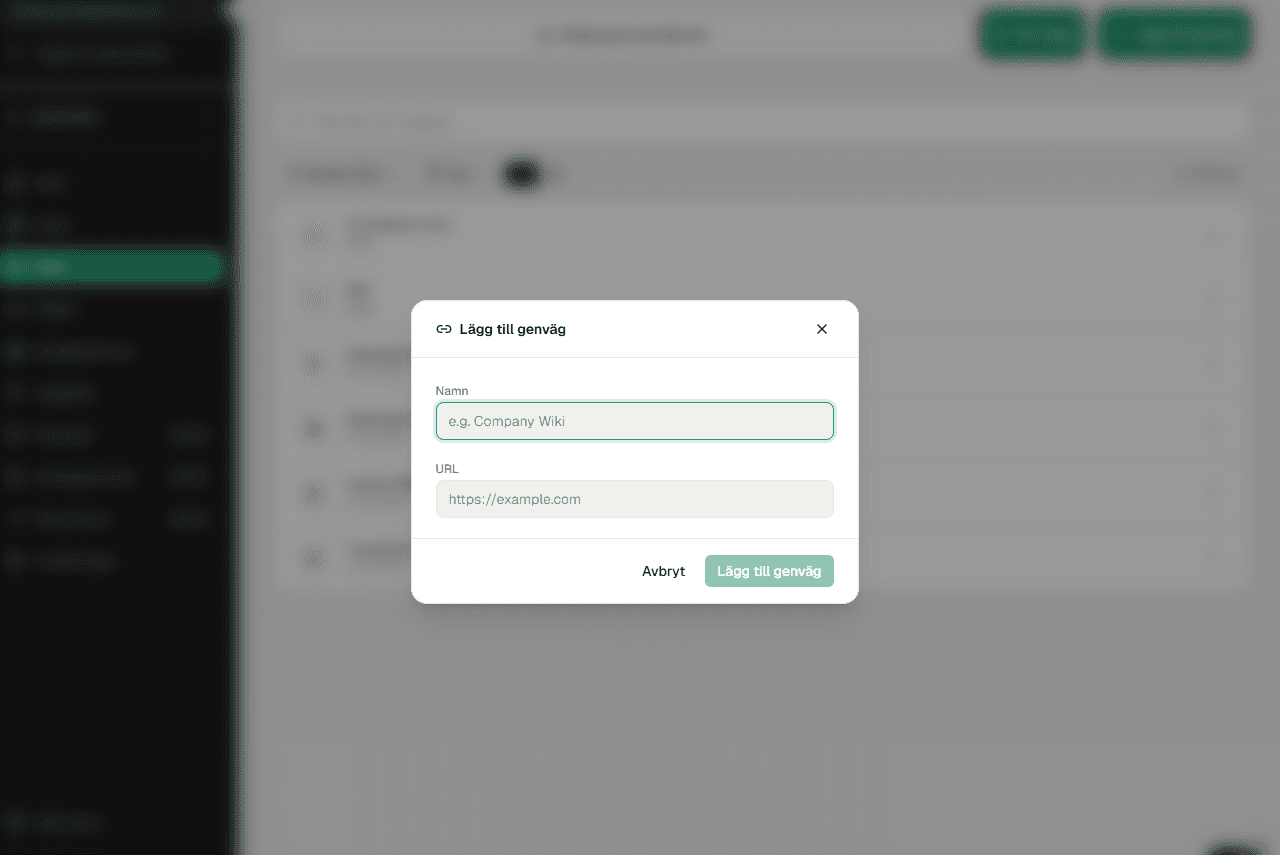
Add links to the systems your board already uses — wiki, finance tools, BankID or in-house apps. Shortcuts live next to the documents, so no one has to hunt for the right URL.
A structured archive for minutes, decisions and board documents. Folders, search and filtering keep the right file one click away — with permission control and a traceable history.
Most boards already have a solution. The problem is that it consists of four.
The material is spread across inboxes, a shared drive, the chair's laptop and a binder. Each part works on its own. Together they mean nobody can say what applied at a given moment.
The inbox holds the history but leaves with the person. When the chair changes, the thread does not follow, and the new chair inherits an empty desk.
The shared folder has no access control that distinguishes director, deputy, auditor and co-opted attendee. Either everyone sees everything, or files are handed out manually every time.
The binder meets the requirement of secure preservation as long as it exists and is complete — but it cannot be searched, and it exists in one place only.
None of them links a decision to the material it rested on, which is exactly the link asked for at audit and review.
Can the auditor have their own access? Yes. The auditor is invited with their own role and sees exactly the documents and meetings needed, with full traceability — at no extra cost, since pricing is not per user.
What happens when a director leaves? Access is revoked but the history stays in the archive. That is the difference from an arrangement where the material lived in that person's inbox.
Can we import old minutes? Yes, and that is the work that makes the archive useful. Load the last few years in numbered order at rollout — it is the step most often skipped.
Where are files stored? Within the EU, encrypted at rest and in transit, with an audit trail of who opened what. You can export everything at any time, and on cancellation data is securely deleted within 30 days.
Does it work for several companies? Get in touch with your structure and we will go through what works today.
Swedish company law requires signing and approval — but says nothing about the format.
Minutes must be signed by the minute-taker and approved by the chair plus, where the board has more than one director, another director appointed by the board. Electronic signatures satisfy that requirement.
The signing flow follows the roles set out in the Companies Act instead of passing a file around and hoping the right people sign.
An advanced electronic signature via BankID identifies the signer, timestamps the signature and makes later changes detectable.
The original is archived with its validation data. A printout of a digitally signed document loses exactly what makes the signature verifiable.
The difference shows up when the chair changes, or when the auditor asks for the material behind a decision from last year.
Director, deputy, CEO, auditor and co-opted attendee each see what they should — not all or nothing.
Every version is kept with its date, so a reader knows which wording applied when the decision was taken.
The document sits on the agenda item it belongs to — which is what shows the decision basis was adequate.
Find the decision without knowing which meeting it was taken at or what the file happened to be called.
Encrypted at rest and in transit, with a full audit trail of who opened what.
Your data belongs to you. Export everything at any time — for audit, migration or cancellation.
Everything that ships with document management.
Board documents require control. With Strictboard you can see who had access to what – and when.
Yes. Swedish company law requires signing and approval but says nothing about the format, so an electronic signature meets the requirement. An advanced electronic signature via BankID also gives stronger traceability than a pen.
You keep access for the rest of the period and can export everything before cancelling. After that your data is securely deleted within 30 days. All data is stored and processed within the EU.
Yes, with their own role and access to exactly the documents and meetings needed, with full traceability. It costs nothing extra because pricing is not per user.
Yes, and it is the work that makes the archive useful. Load the last few years in numbered order at rollout — the step most often skipped, and the one that decides whether the archive can be relied on.
There the registrar's requirements for that particular filing govern, and they differ. Always keep the electronic original with its validation data — a printout of a digitally signed document loses what makes the signature verifiable.